
Can Stairlifts Be Fitted to Any Stairs?
Stairlifts can usually be fitted to any stairs, providing an immediate mobility solution without requiring structural home modifications. If you or a loved one struggles to navigate the steps due to illness, injury, or age, you need to know how a stairlift (also called a chair lift or stair glide lift) will fit your existing stairs.
Straight Staircases
A straight staircase is the easiest type of stairs to fit with a lift. It is also the most cost-efficient. Most stairlifts will fit a straight staircase of any length. Technicians custom-cut railing sections to match the exact distance of the stairs.
Very long staircases will require the installation team to add more track sections. If you have a staircase with only one to three steps, a wheelchair ramp or vertical wheelchair lift is a better alternative.
Staircases With a Door at the Top of the Stairs
Staircases with a door at the top or bottom are still able to accommodate a stairlift with minor equipment adjustments. Many people imagine a stairway ending in an open landing or room at the top. In reality, many home layouts have a door right at the top or bottom of the stairs.
In most cases, technicians solve this layout issue by installing a straight stairlift with a higher rail and an adjusted seat height. The extra height leaves enough space for the user to get on and off the chair and for the door to open and close normally.
Narrow Staircases
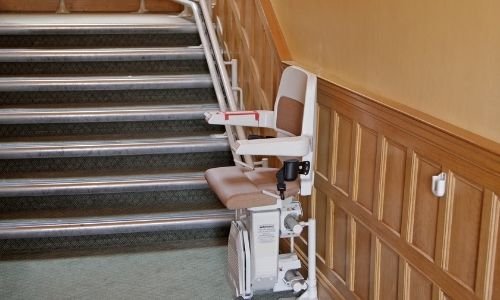
Very narrow stairs present an installation challenge. However, specific equipment designs ensure a secure fit. While modern houses offer ample space for stairlifts, older houses frequently have tighter staircases. For an especially narrow staircase, you have two main options.
Collapsible Seat
A stairlift with a collapsible seat folds up against the wall when not in use to keep the walkway clear. The staircase must still be wide enough for the seat and the user to travel up and down safely.
Perch Seat
A perch seat positions the user so that they are almost standing up. This option typically won’t work for users who struggle with balance or can't stand without support. However, it’s often the only solution if other kinds of stairlifts don’t fit.
In our Denver and Boulder showrooms, we also have an option where the seat can "turn" so you go up and down the stairs with your knees facing down the stairwell instead of across. These are more expensive, but a possible solution for extremely narrow stairwells.
Split Staircases
Split stairways have intermediate landings or change directions at a 90- or 180-degree angle before continuing to the next floor. For these layouts, installing a series of straight stairlifts positioned close together allows for an easy transition.
A custom curved stairlift that goes around the bend is another option for a staircase that changes direction. However, bending the track at exact angles for a smooth turn requires significant time and professional expertise. Because of the custom engineering required, this option increases the overall stairlift cost compared to buying two standard straight stairlifts.
Curved Stairs
Curved or spiral staircases require a custom stairlift engineered to match the exact curve of your steps. Custom stairlifts are an especially practical solution for historical buildings with ornate stairwells. Because each curved staircase is unique, you usually won't be able to resell the custom-made stairlift rail or return it to the manufacturer.
Curved stairlift installation requires professional expertise and experience. It must not be attempted by an amateur. Your life or that of your loved one is at stake. Hire a professional to install the curved rails for maximum stairlift safety and full peace of mind.
Wooden, Concrete, and Carpeted Staircases
Stairlift units can be installed on almost any staircase surface because the mounting brackets attach directly to the stair treads (steps). The type of material simply determines the specific fasteners the installer needs to use to secure the track.
Homeowners frequently ask how different materials affect the installation process:
Wooden Stairs: Installers safely retrofit a unit using heavy-duty wood screws to secure the brackets without splitting the timber.
Concrete or Brick Stairs: The installation requires specialized masonry anchors to lock the brackets into place securely.
Carpeted Stairs: These require mounting bolts that go right through the carpet and padding into the underlying structural treads.
Outdoor Staircases
Outdoor staircases at beaches, docks, train stations, and public swimming pools are typically straight and easily accommodate a stairlift. These setups require specialized units constructed with weatherproof materials and durable tracks built for outdoor use.
These stairlifts can be installed on exterior masonry stairs made of stone, concrete, or brick. If you require an outdoor stairlift, the best approach is to consult with an accessibility equipment provider like Mobility Plus Colorado (serving customers in Denver, Boulder, and throughout the state) for an on-site evaluation to check your steps and plan the best layout.
Stairlift Installation Challenges
Some existing stair problems require extra planning or repairs before a stairlift is installed.
Broken Steps: Loose or cracked stairs must be repaired before adding a lift so they support the mounting brackets.
Sharp Angles: Very steep stairs or unusually shaped steps require special custom tracks instead of standard factory parts.
Blocked Paths: Technicians use three main fixes to clear the space:
Fixtures and Trim: Wall heaters, low-hanging lights, or trim are removed, relocated, or bypassed with a slim chair.
Low Ceilings: A perch seat, single-tube rails, or swivel adjustments keep the rider lower to clear the ceiling.
Nearby Doors: A retractable rail or a folding rail that flips up will clear the doorway.
Minimum Requirements for Stairlift Installation
A successful stairlift installation depends on matching the equipment to your physical space and the specific rider. Review the full structural and spatial requirements for your stairlift to ensure a safe, unhindered ride up and down the steps.
There are four primary requirements for standard stairlift installations:
Staircase Width: A minimum width of 29 to 36 inches so the chair can navigate the path without striking the wall or banister.
User Clearance: The rider’s back-to-knee measurement determines how much space their legs will occupy while seated. This measurement ensures the rider’s knees won’t brush against the opposite wall or spindle during transit.
Power Source: Stairlifts run on batteries but require a standard, dedicated electrical outlet nearby to keep the continuous charging system powered.
Landing Clearance: There must be sufficient space at both the top and bottom of the stairs to allow the user to safely park, fold, mount, and dismount the chair without obstructing hallways or doorways.
Custom Stairlift Considerations
Custom stairlifts that are engineered for a specific staircase’s layout, angles, and turns generally can’t be resold. While a stairlift can be fitted to any stairs, it’s not always cost-effective to do so.
All custom stairlift installations must follow the American Society of Mechanical Engineers’ Code A18.1 Safety Standard for Platform Lifts and Stairway Chairlifts. This code regulates equipment design, testing, and maintenance for mobility devices. Recent updates now require failsafes like speed governors or drive-component backup systems to prevent overspeed failures.
If you're not sure whether a custom stairlift solution would be worth the cost, a home evaluation will help you compare the options available. You might find out that renovating a ground-floor living area costs less than adding custom stairlift units to multiple curved staircases.
Keep in mind that a custom stairlift usually costs significantly less than moving into an assisted living facility. This is especially true when balancing the price against the mental and emotional costs of leaving home. All or part of the cost of your custom stairlift may be tax deductible.
Make the Decision That's Right for You
Choose the right standard or custom-made stairlift by carefully looking at your specific home layout, budget, and long-term goals. A professional quotation will give you a clear baseline against which to compare all your options. Weigh these expenses against your personal values to find the best path forward for you and your family.
When going the stairlift route, entrust your installation to experienced experts so your straight or curved stairlift operates safely. A stairlift exists to prevent accidents and falls while giving the user as much mobility as possible. The right stairlift for your stairs, installed correctly, and adapted to the user's needs, is a life-changing piece of equipment.