
What Is a Vertical Platform Lift & Is It Right for You?
People who are exploring accessibility options for their home, institution, or outdoor building project are likely to have come across the term "vertical platform lift" and may wonder what a vertical platform lift is.
In the most basic terms, a vertical platform lift or wheelchair lift is a small elevator that lifts mobility devices and their riders from one level to another. Vertical platform lifts can be used to provide access to wheelchairs and other mobility devices when a wheelchair ramp or elevator would be too cumbersome or not cost-effective to install.
What Is a Vertical Platform Lift?
A vertical platform lift (also referred to as a wheelchair lift) is a mechanical device that provides access to individuals with mobility issues to navigate between different levels of a house or a building.
Think of vertical platform lifts like small elevators that are equipped with safety rails, non-slip platforms, and other features that allow users to operate the lifts with minimal assistance. Vertical platform lifts offer independence and mobility for individuals who use wheelchairs and other mobility devices.
Components of Vertical Platform Lifts
Vertical platform lifts consist of a tower or drive mast, a platform, a landing gate or door, a battery, and a small ramp for mounting. Battery backup systems are typically available for power outages to ensure the lifts can still function when the home or business power goes out.
Most lifts also have added safety features, including grab bars, polycarbonate gates or doors, obstruction sensors, and an emergency button to bring the lift to a sudden halt. Depending on the height of the lift, it may have one stop or multiple stops on the way up or down. Vertical platform lifts have a maximum lifting height of 14 feet.
How a Vertical Platform Lift Works
To use the lift, the wheelchair or mobility scooter user drives up the ramp and onto the platform and presses a button to go up or down. The ramp can either be fixed or fold up automatically to secure the mobility device until it reaches the top of the lift. At the top, the landing gate folds down for a smooth exit.
Types of Vertical Platform Lift
There are several types of vertical platform lifts that are used for different applications:
Unenclosed vertical platform lift: This is the most basic kind of platform lift. It is typically used for shorter lifting heights and outdoor applications.
Enclosed vertical platform lift: This is a cross between a vertical platform lift and an elevator. The entire journey of the lift is enclosed in a cage.
Shaftway platform lift: The lift travels up through a roofless shaft where the user exits onto the landing.
Inclined platform lift: Inclined platform lifts are like stairlifts except that they transport the user and their mobility device up a flight of stairs.
Where Vertical Platform Lifts Can Be Used
Vertical platform lifts are used in residential settings, in commercial settings, and for outdoor applications where there is not enough space for a ramp, including:
Decks (called a deck lift)
Porches (these are referred to as porch lifts)
Garages
Residential buildings
Commercial buildings
Public buildings
Places of worship
Schools
Stadiums
Stages
Vertical platform lifts are sometimes an option instead of a stairlift for split-level homes. Either an inclined platform lift or a straight platform lift can be used, depending on how much space is available.
How to Have a Vertical Platform Lift Installed
To have an indoor or outdoor vertical platform lift installed, you will need to book an on-site assessment for the construction of your custom lift and choose between the available models, weight limits, and designs. Our showrooms in Denver and Boulder, for example, have vertical platform lifts with weight limits up to 800 lbs.
Before installation, you will also need to check your local building codes (including ADA requirements for platform lifts if applicable), find out whether you need permission to install the lift, and make sure a power outlet is available for the electrical wiring that connects to the lead-acid battery. Once your custom design has been manufactured, a basic lift takes around six hours to install.
Vertical Platform Lift Cost
The cost of a vertical platform lift will vary depending on the size, height, features, and installation requirements.
Basic vertical platform lifts start at around $5,000, with mid-range models starting closer to $8,000. Inclined platform lifts cost $2,000 to $5,000, depending on length and rail design. Fully equipped vertical lifts with “all the works” and premium features may reach up to $20,000.
Vertical Platform Lifts vs Inclined Platform Lifts
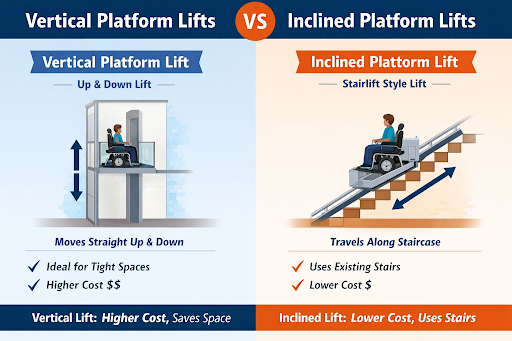
Vertical platform lifts help individuals move their mobility devices straight up and down from one point to another. This solution is ideal in a location where a wheelchair ramp wouldn’t be practical.
An inclined platform lift, on the other hand, is installed on an existing staircase and travels up and down with the user and their mobility device on board. They generally cost less than vertical platform lifts.
Vertical Platform Lift: A Safe and Convenient Solution
When a wheelchair ramp isn't an option, vertical platform lifts offer a safe and convenient way to move from one level to another while riding in a wheelchair or mobility scooter. Various models are available for different applications and may be designed with multiple stops.
If you are interested in having a vertical platform lift installed, contact an experienced mobility solutions provider to discuss your requirements and find out which kind of vertical platform lift might be best for your specific situation.